Sophie™ • Technical-analysis category

AQS-RSI ADX ATR PRO

A momentum-confirmation Expert Advisor for MetaTrader 5 that combines RSI cross-out signals, ADX trend-strength filtering, and ATR-based adaptive risk controls. The strategy is designed around disciplined execution, one-position logic, and systematic trailing management.

Buy on MQL5 – Pricing, live stats & reviews Read our testing standards
Indicator logic, systematic discipline
This EA is engineered to operate on completed bar data, with internal indicator calculation, broker-aware safeguards, and execution controls designed for real-market deployment.

RSI entries, ADX confirmation, ATR control

The strategy detects RSI exits from oversold / overbought zones, validates directional strength using ADX, and applies ATR-based stop-loss, target, and trailing logic for volatility-aware trade management.
AQS RSI ADX ATR PRO
Market
FX / Indices
Timeframe
Best for M15 / M30 / H1
Style
RSI reversal with trend-strength confirmation
Risk controls
ATR SL/TP • Spread • Cooldown • Trailing
Best use
Disciplined portfolio component
How it trades
Signal detection At each new closed bar, RSI is evaluated for a cross-out from oversold or overbought conditions over the recent lookback window.
Trend validation ADX confirms minimum trend strength and can optionally require directional bias via +DI / -DI alignment.
Execution Market entries are placed only if spread, position-count, and one-position discipline rules allow execution.
Risk & exits ATR defines the initial stop-loss and target distances; optional trailing then adapts the stop as price advances toward the original target.
RSI logic ADX filter ATR-managed risk

Trading logic summary

  • Signal driver: RSI crossing back above oversold or below overbought over the last N closed bars.
  • Confirmation: ADX minimum-strength filter with optional directional +DI / -DI validation.
  • Risk management: ATR-based stop-loss and take-profit distances adapt to recent volatility.
  • Exposure control: no averaging, no pyramiding, optional one-position-only discipline.
  • Operational filters: spread cap, cooldown bars, slippage control, and maximum-position safeguards.
Important note
Our models are continuously monitored in live conditions and recalibrated when market dynamics change. When an update is required, recalibration notes and configuration updates are shared transparently with our community.

Key strategy features

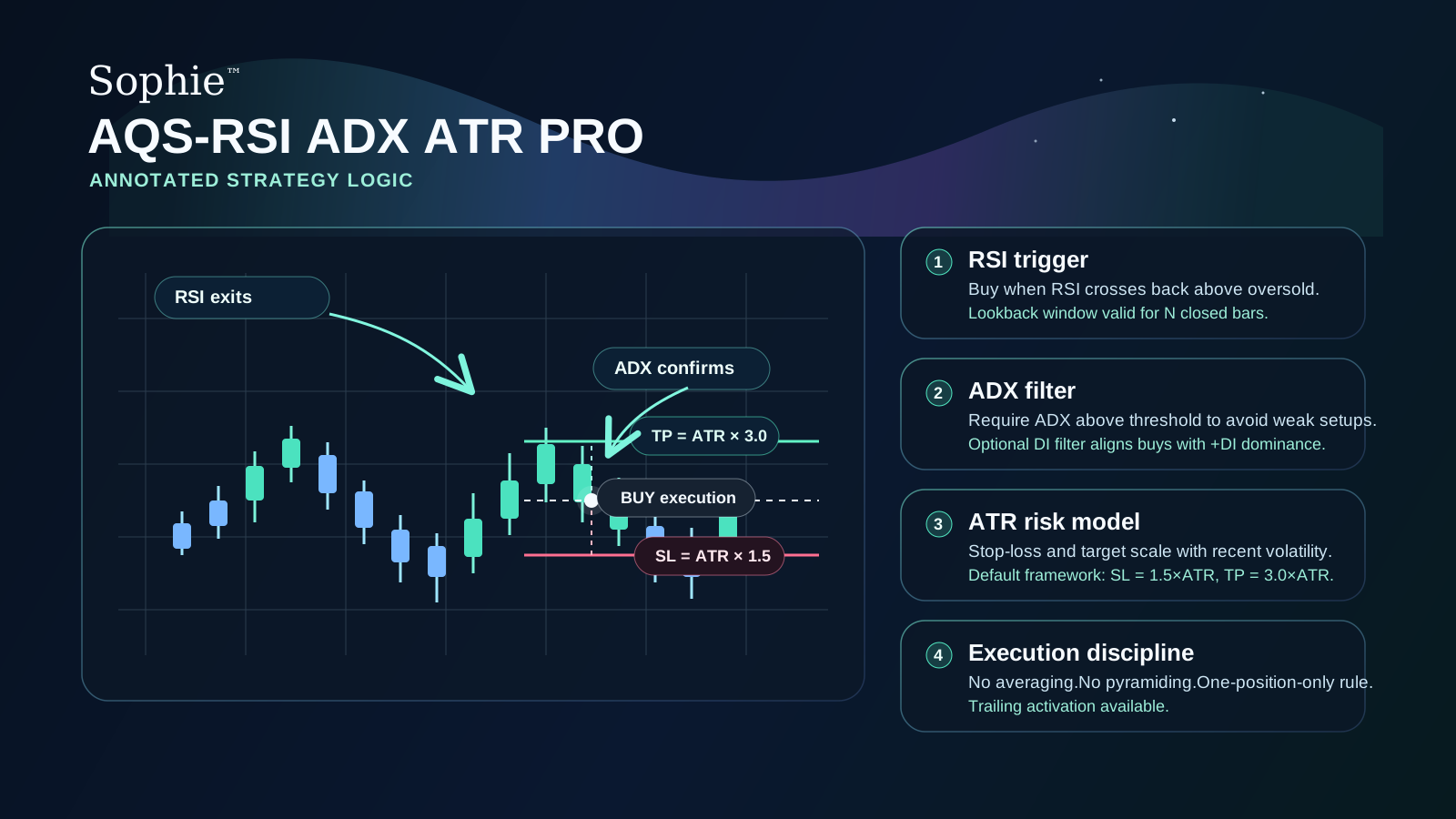
The diagram below illustrates how AQS-RSI ADX ATR PRO evaluates RSI cross-out signals, validates trend strength with ADX, calculates ATR-based stop and target distances, and applies disciplined trailing logic. It is intended to visualise the decision flow and operational logic rather than represent historical or live performance.
AQS RSI ADX ATR PRO strategy illustration
  • RSI signal logic: buy when RSI exits oversold; sell when RSI exits overbought within the configured lookback window.
  • ADX confirmation: entries only allowed when trend strength exceeds the minimum threshold, with optional DI direction filter.
  • ATR risk model: stop-loss and take-profit distances scale with current market volatility.
  • Trade management: trailing stop activates after a configurable percentage of original target distance is reached.

Why an RSI + ADX + ATR strategy?

Momentum reversals become more robust when entry timing, directional validation, and volatility-adjusted risk are treated as one integrated process. AQS-RSI ADX ATR PRO formalises this concept into a fully systematic, repeatable trading framework.

RSI cross-out logic

  • Signals are based on RSI leaving oversold or overbought conditions.
  • Lookback window allows recent crosses to remain valid for a limited number of closed bars.
  • Internal calculation avoids external indicator dependency.

ADX strength filter

  • Minimum ADX threshold helps avoid weak, low-conviction setups.
  • Optional +DI / -DI direction filter aligns entries with directional pressure.
  • Internal ADX calculation keeps the logic self-contained and portable.

ATR-based risk engine

  • Stop-loss and target distances scale with prevailing volatility.
  • More adaptive than fixed-pip exits across different symbols and regimes.
  • Helps maintain consistent structural risk logic across market conditions.

Single-position discipline

  • No averaging and no pyramiding.
  • Optional one-position-only mode reduces overlap and decision clutter.
  • Cooldown logic can prevent immediate re-entry after trade completion.

How the strategy works

The EA follows a strict event-driven lifecycle, ensuring that entries are only evaluated on new bars and that every trade is protected by clearly defined volatility-aware exit logic.

01 Evaluate RSI signal
On each new bar, the EA checks whether RSI has recently crossed back above the oversold threshold or below the overbought threshold.
02 Validate with ADX
The setup must pass the ADX minimum-strength filter, and optional directional validation can require +DI dominance for buys or -DI dominance for sells.
03 Open ATR-defined trade
If spread, slippage, cooldown, and position-count controls pass, the EA opens a trade with stop-loss and take-profit distances derived from ATR multiples.
04 Manage trailing and exits
Once price reaches a configurable share of the original target distance, the stop-loss can trail by a defined percentage of that same target framework.

Key features

Signal engine

  • Internal Wilder RSI calculation.
  • Configurable oversold / overbought thresholds.
  • Cross validation over the last N closed bars.

Trend-strength filter

  • Internal Wilder ADX framework.
  • Configurable minimum ADX threshold.
  • Optional directional DI confirmation.

Stops & targets

  • ATR-based stop-loss multiplier.
  • ATR-based take-profit multiplier.
  • Volatility-aware exit sizing across symbols.

Trade management & safety

  • Optional trailing based on original target distance.
  • Max spread and max position filters.
  • One-position-only and cooldown logic.

Configuration overview

  • General inputs: magic number, slippage allowance, and one-position-only discipline.
  • RSI inputs: period, applied price, overbought / oversold levels, and valid cross lookback window.
  • ADX inputs: period, minimum trend-strength threshold, and optional DI direction filter.
  • ATR inputs: period plus stop-loss and take-profit ATR multipliers.
  • Risk inputs: base lot size, broker-aware min/max lot handling, and cooldown bars.
  • Execution filters: maximum total positions and optional spread cap.
  • Trailing inputs: activation threshold and trailing distance as percentages of original TP distance.
  • Operational design: no averaging, no pyramiding, and new-bar execution discipline.
  • Research workflow: CSV export support for deterministic optimisation and OOS analysis pipelines.

Performance, pricing, and delivery

MQL5 product page

Complete performance statistics, optimisation notes, and licensing details are published on the official MQL5 product page.

Buy on MQL5 – Pricing, live stats & reviews

Important note

Our models are continuously monitored in live conditions and are recalibrated when market dynamics change. When an update is required, the recalibration and release notes are shared transparently with our community through our official channels.

Contact AQS support

Research updates