Validation framework

Robustness-first testing designed for real execution

AuroraQuantSystems evaluates strategies using a multi-stage validation framework focused on stability, drawdown behaviour, and operational realism. Research is conducted primarily across liquid FX pairs and major equity indices to ensure sufficient market depth, execution quality, and repeatability.

Data coverage
IS/OOS windows
Cross-window checks
Operational review
Priority
Robustness first
Method
Multi-stage validation
Assumptions
Conservative execution
Our objective
We prioritise strategies that demonstrate controlled drawdowns and consistent behaviour across different market regimes, rather than peak backtest performance achieved in isolated or idealised conditions.
Validation cycle

Performance cycle overview

A simplified visual representation of our validation loop. Emphasis is placed on repeatability, drawdown control, and operational realism rather than isolated peaks.
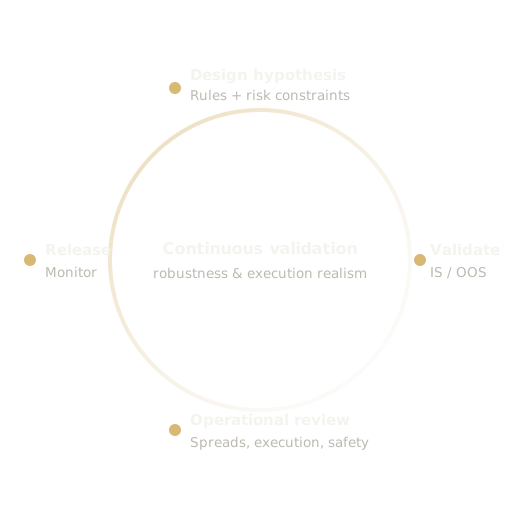
Performance validation cycle

Conservative execution assumptions

A key differentiator of AuroraQuantSystems is that strategies are researched, developed, and validated under deliberately conservative execution conditions.

Testing is always performed under conditions that include wider spreads, higher transaction costs, and unfavourable swap dynamics — such as those encountered in spread betting accounts.

This approach is intentional. Strategies that remain profitable under difficult execution conditions are more likely to demonstrate robustness when deployed under standard or more favourable trading environments.

Performance information

  • Website: outlines our research methodology and validation discipline.
  • MQL5 product pages: provide strategy-specific statistics, configuration notes, licensing, and updates.
  • Support: operational guidance and ongoing assistance.
Validation focus strip

Testing principles

Our framework is designed to reduce overfitting risk and to assess whether a strategy remains stable when conditions change. We explicitly avoid “single period optimisation” decision-making.

Multi-regime coverage

  • Use extended historical horizons to capture varied conditions.
  • Assess behaviour across trending, ranging, and high-volatility environments.

Conservative assumptions

  • Emphasis on execution realism: spreads, slippage sensitivity, and session effects.
  • Strategies are designed and tested under conservative conditions.

Robustness over peak returns

  • Preference for controlled drawdown and stable equity behaviour.
  • Focus on consistency across windows rather than one exceptional run.

Production standards

  • Strategies are released only after meeting robustness and operational criteria.
  • Not all research outputs become published strategies.