Sophie™ • Mean Reversion category

AQS-Linear Regression Mean Reversion PRO

A quantitative mean-reversion Expert Advisor for MetaTrader 5 that models price behaviour around a dynamic linear regression equilibrium. Trades are executed when price deviates statistically from its regression path, with structured scaling, volatility-aware exits, and layered capital protection.

Buy on MQL5 – Pricing, live stats & reviews Read our testing standards
Quantitative mean reversion, risk-first design
This strategy is engineered to operate under realistic execution constraints, with explicit controls on exposure, frequency, drawdown, and adverse market regimes.

Regression-based equilibrium

Price is evaluated relative to a rolling regression channel, allowing entries only when statistically significant deviations occur.
AQS Linear Regression Mean Reversion PRO
Market
FX / Indices
Timeframe
Best for M30 / H1
Style
Mean reversion
Risk Control
ATR exits • Exposure caps • Safeguards
Best Use
Multistrategy portfolio component
How it trades
Mean reference Linear regression channel defines fair value
Deviation detection Price extends beyond configurable deviation bands
Entry Rule-based mean-reversion execution
Risk & exits ATR-based stops, targets & exposure caps
Mean reversion Non-discretionary Risk-controlled

Trading logic summary

  • Core model: linear regression defines a dynamic fair-value axis.
  • Signal: entries triggered when price deviates beyond statistical bands.
  • Execution: trades placed only on confirmed bar close events.
  • Risk management: ATR-based stop-loss and take-profit with optional trailing.
  • Operational controls: spread filters, position caps, and cooldown logic.
Important note
Mean-reversion behaviour is regime-dependent. Models are continuously monitored and recalibrated when market dynamics change. Any updates are shared transparently with our community.

Key strategy features

The diagram below illustrates how AQS-LinReg Mean Reversion PRO defines a dynamic fair-value reference using linear regression, detects statistically meaningful deviations, and executes mean-reversion entries under strict operational filters and risk controls. It is intended to visualise the decision flow and logic rather than represent historical or live performance.
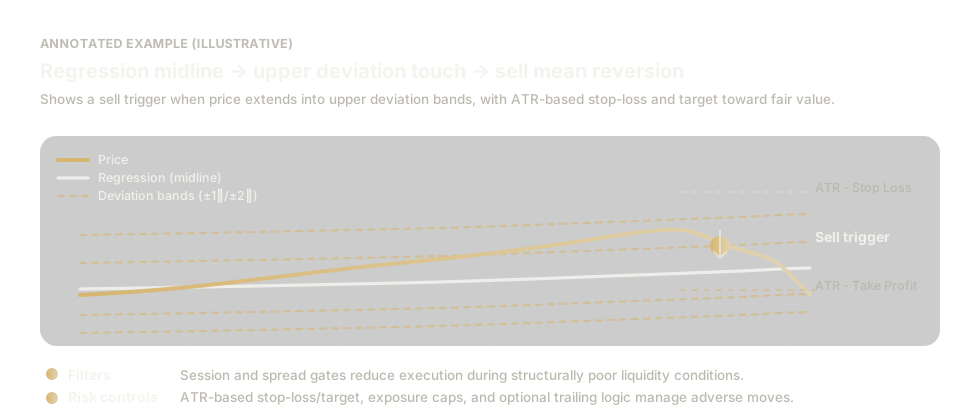
Illustrative annotated example of Linear Regression mean reversion: fair-value reference, deviation bands, entry trigger, and risk controls
  • Fair value reference: regression line estimates the evolving mean for the active window.
  • Deviation trigger: entries occur only when price extends beyond configurable deviation bands.
  • Mean reversion execution: trades are confirmed on bar close and managed systematically.
  • Risk & safeguards: ATR-based SL/TP, optional trailing, exposure caps, and spread/session filters.

Why a linear regression mean-reversion strategy?

Many mean-reversion systems rely on fixed indicators or static thresholds. AQS-Linear Regression Mean Reversion PRO instead adapts dynamically to changing price structure by recalculating the equilibrium on every bar.

Adaptive equilibrium

  • Regression line recalculated continuously on recent data.
  • Deviation bands scale with observed volatility.
  • Responsive to both range-bound and trending regimes.

Statistical entry logic

  • Entries triggered only on confirmed cross-back events.
  • Multiple deviation zones (standard and extreme).
  • Gradient-aware logic to adjust behaviour by trend context.

Controlled scaling

  • Incremental entries spaced by minimum price distance.
  • Scaling intensity adapts to signal strength and regime.
  • Hard cap on total concurrent positions.

Capital protection layers

  • ATR-based dynamic stop-loss and take-profit.
  • Pre-trail partial risk reduction when trades move adversely.
  • Equity-based and monetary catastrophic protection.

How the strategy works

The EA operates on a bar-by-bar decision framework, ensuring deterministic behaviour and consistent execution.

01 Compute regression equilibrium
A rolling linear regression is calculated over recent price data, producing a dynamic equilibrium line and deviation bands.
02 Detect statistical deviations
Price excursions beyond standard or extreme deviation zones are monitored for confirmed reversal signals.
03 Execute structured entries
Trades are opened only when execution gates, spread filters, and regime checks are satisfied.
04 Manage exits and risk
ATR-based stops, trailing logic, partial reductions, and hard safety limits are enforced continuously.

Key features

Signal engine

  • Linear regression equilibrium model.
  • Multiple deviation thresholds.
  • Cross-confirmation on completed bars.

Stops & targets

  • ATR-based stop-loss and take-profit.
  • Volatility-adjusted displacement buffer.
  • Automatic broker constraint enforcement.

Position sizing

  • Fixed base position size.
  • Adaptive lot multipliers by signal type.
  • Maximum concurrent exposure enforced.

Trade management & safety

  • Trailing stop once profitability threshold is reached.
  • Pre-trail partial close to reduce early adverse risk.
  • Equity drawdown and monetary catastrophic stops.

Configuration overview

  • Regression model settings: Controls equilibrium window and deviation sensitivity.
  • Signal qualification: Defines standard versus extreme reversion thresholds.
  • Scaling behaviour: Determines spacing and intensity of additional entries.
  • Trade frequency limits: Caps daily trades and enforces cooldowns.
  • Volatility-based exits: ATR-driven stop-loss and take-profit logic.
  • Risk reduction: Optional pre-trail partial position reduction.
  • Capital protection: Equity drawdown and basket-level loss limits.
  • Execution filters: Spread, session, and broker constraint safeguards.

Performance, pricing, and delivery

MQL5 product page

Full performance statistics, optimisation notes, and licensing details are available on the official MQL5 product page.

Buy on MQL5 – Pricing, live stats & reviews

Important note

Our models are continuously monitored in live conditions and are recalibrated when market dynamics change. When an update is required, the recalibration and release notes are shared transparently with our community through our official channels.

Contact AQS support

Research updates