Sophie™ • Trend Following category

AQS-HMA Trend PRO

A systematic trend-following Expert Advisor for MetaTrader 5 that models directional structure using a fast/slow Hull Moving Average framework. The strategy enters on confirmed trend resumption, optionally scales into persistent moves, and embeds production-grade execution safety and drawdown containment.

Buy on MQL5 (Pricing, live stats and reviews) Read our testing standards
Production safety patch included
This PRO build includes explicit spread/position guards, cooldown controls after forced exits, optional time-based exits, and pre-trail risk reduction to improve resilience under real execution conditions.

HMA-driven trend structure

Trend direction and reversal structure are derived from dual HMA behaviour, with ATR-based exits and optional higher-timeframe ADX regime validation.

AQS HMA Trend PRO
Market
FX / Indices
Timeframe
Best for M30 / H1
Style
Trend Following
Risk Control
ATR exits • Exposure caps • Safeguards
Best Use
Multistrategy portfolio component
How it trades
Trend detection Fast / slow HMA alignment
Confirmation Optional higher-timeframe & strength filters
Entry Rule-based market execution
Risk & exits ATR-based stops, trailing & exposure caps
Trend-following Non-discretionary Risk-controlled

Trading logic summary

  • Trend engine: entries driven by the relative positioning and slope of Hull Moving Averages.
  • Direction filter: optional higher-timeframe confirmation to reduce counter-trend exposure.
  • Entry logic: trades executed only when alignment conditions persist at bar close.
  • Risk management: ATR-based stop-loss and take-profit with optional trailing logic.
  • Operational controls: spread filters, maximum positions, and trade cooldown logic.
Important note
Models are continuously monitored in live conditions and recalibrated when market dynamics evolve. Any material updates or configuration changes are communicated transparently to our community.

Key strategy features

The diagram below illustrates how AQS-HMA Trend PRO identifies directional bias using Hull Moving Average alignment, applies confirmation and execution filters, and manages risk through systematic stop and trailing rules. It is intended to visualise the decision flow and operational logic rather than represent historical or live performance.
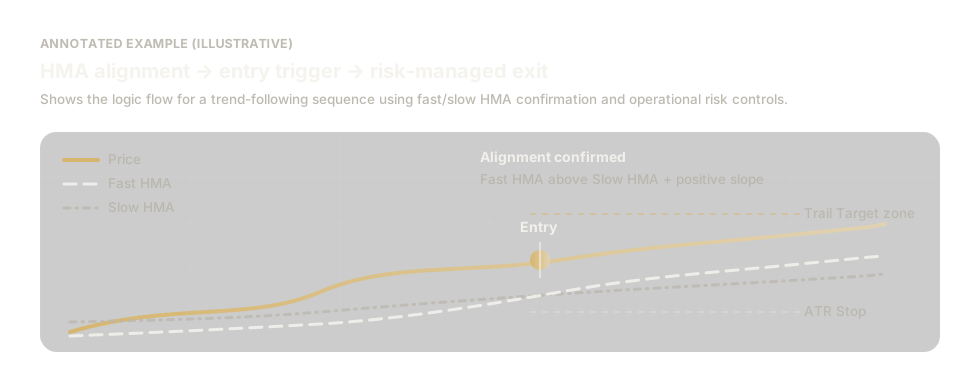
Illustrative annotated example of HMA Trend alignment, entry trigger, and risk controls
  • Trend definition: fast/slow HMA alignment and slope determine directional bias.
  • Entry trigger: trades execute only when alignment persists on confirmed bar close.
  • Filter layer: optional session/spread/strength gates reduce low-quality conditions.
  • Risk & exits: ATR-based stops plus optional trailing logic and exposure caps.

Why a Hull MA trend system?

Trend-following performance depends on efficient directional detection and disciplined risk containment during adverse regime shifts. AQS-HMA Trend PRO uses a fast/slow HMA structure to capture trend continuation while applying volatility-aware stops, pyramiding constraints, and explicit production guards.

Directional structure

  • Fast/slow HMA framework to model trend direction.
  • Entry logic designed for trend resumption, not noise chasing.
  • Automatic cycle reset behaviour on confirmed slow-structure turning points.

Volatility-aware exits

  • Stop-loss and take-profit derived from ATR dynamics.
  • Additional displacement buffer to reduce stop clustering.
  • Broker constraint enforcement for stop placement robustness.

Controlled pyramiding

  • Optional scale-ins only after price moves a defined ATR step in favour.
  • Minimum bar spacing between adds to prevent overtrading.
  • Configurable lot progression (flat / taper / grow).

Safety-first execution

  • Spread guard and maximum position cap (symbol + strategy instance).
  • Basket-level catastrophic loss limit with cooldown after stop.
  • Optional time stop to limit exposure duration in unstable conditions.

How the strategy works

The EA follows a deterministic workflow: risk controls are enforced continuously, while trade decisions occur on bar boundaries to reduce noise and execution churn.

01 Compute trend structure
The strategy computes fast and slow HMA values internally to model directional bias and trend turning points.
02 Validate regime (optional)
If enabled, a higher-timeframe ADX filter restricts entries to sufficiently strong directional environments.
03 Execute entries and scale-ins
Initial entries trigger on confirmed HMA resumption logic. Additional entries are allowed only under strict pyramiding constraints and only after favourable ATR progress.
04 Manage exits and protections
ATR-based stops/targets, pip trailing, time stop, and basket catastrophic loss protection operate as continuous safety layers.

Key features

Trend engine

  • Internal dual-HMA computation for deterministic behaviour.
  • Fast reversal pattern recognition aligned with slow trend direction.
  • Cycle resets on slow turning points to prevent stale exposure.

ATR risk model

  • ATR-derived stop-loss and take-profit.
  • Stop displacement buffer for improved robustness.
  • Stop placement clamped to broker minimum distances.

Pyramiding controls

  • Maximum entries per trend cycle.
  • ATR-step requirement before adding exposure.
  • Lot progression configurable by pyramid factor.

Production-grade guards

  • Spread filter and total position cap.
  • Basket catastrophic loss limit with enforced cooldown.
  • Optional time-based position ageing exit.
  • Pre-trail partial risk reduction before trailing activation.

Configuration overview

  • Trend structure: Controls the fast/slow HMA framework and applied price source.
  • Trade sizing: Defines base position size and lot progression for scale-ins.
  • Pyramiding rules: Sets maximum entries per cycle, ATR step requirement, and bar spacing between adds.
  • Volatility exits: Configures ATR-based stop-loss and take-profit, including displacement buffering.
  • Regime filter (optional): Enables a higher-timeframe ADX threshold gate for entries.
  • Trailing policy: Starts trailing after defined profit and maintains a pip-based distance.
  • Safety guards: Spread and maximum position caps to avoid degraded execution conditions.
  • Basket protection: Catastrophic loss limit with cooldown after stop-triggered liquidation.
  • Time stop (optional): Closes positions exceeding a defined age to constrain exposure duration.
  • Pre-trail risk cut: One-shot partial reduction if price moves materially toward stop-loss before trailing begins.

Performance, pricing, and delivery

MQL5 product page

Full performance statistics, optimisation notes, and licensing details are available on the official MQL5 product page.

Buy on MQL5 (Pricing, live stats and reviews)

Important note

Our models are continuously monitored in live conditions and are recalibrated when market dynamics change. When an update is required, the recalibration and release notes are shared transparently with our community through our official channels.

Contact AQS support

Research updates